

Over the past week, we have witnessed another major geopolitical conflict, this time between Israel and Iran.
Recent footage and news coverage of escalating rocket exchanges between conflicting sides have been deeply unsettling. Our hearts go out to the innocent civilians caught in the crossfire, whose suffering is difficult to fathom. These moments serve as poignant reminders of how fortunate many of us are to be safe alongside our loved ones.
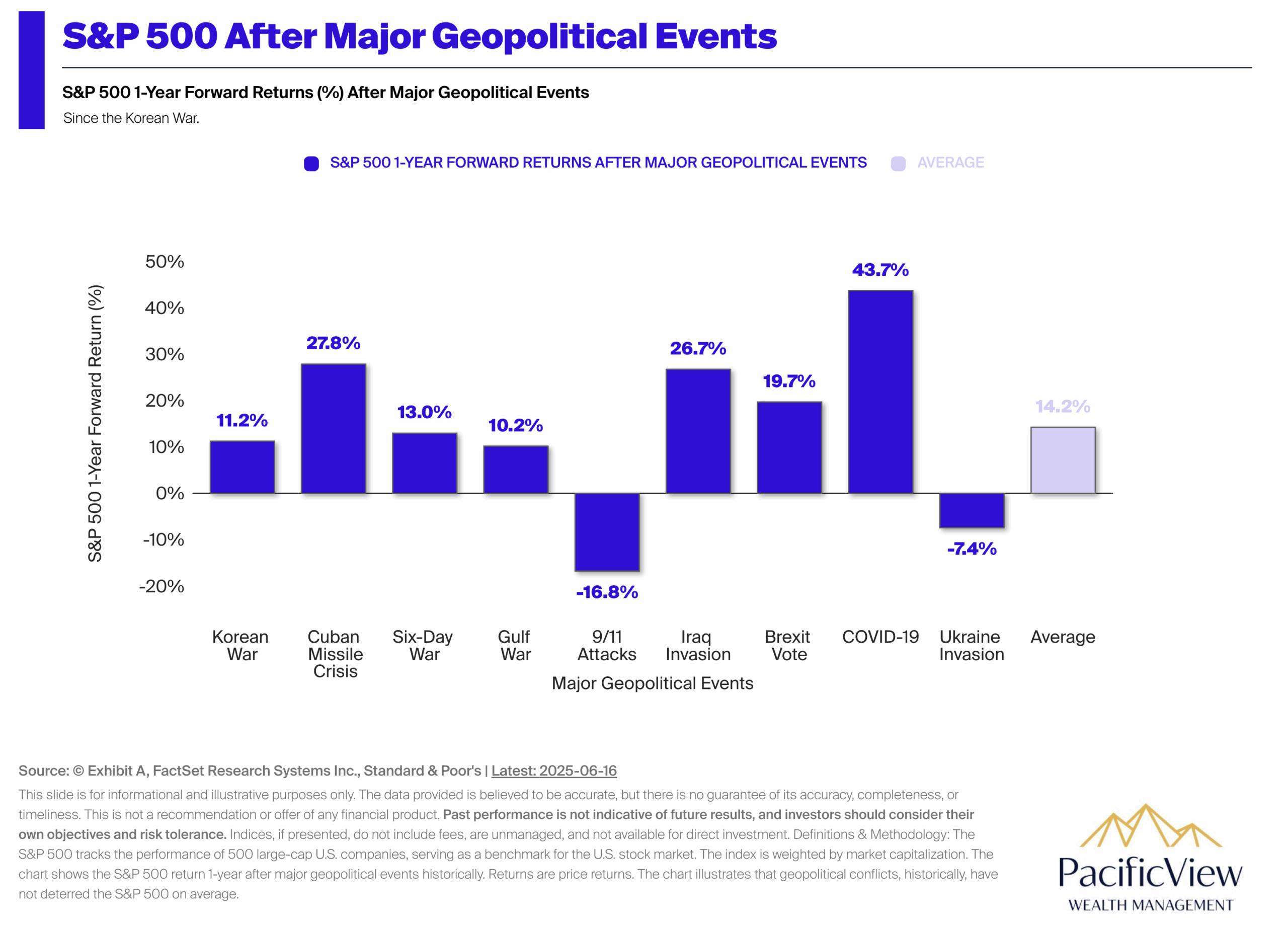
Geopolitical events such as wars, conflicts, and political unrest often trigger short-term market volatility and investor uncertainty. Yet, historical data reveals a more reassuring narrative. While these crises can cause immediate market pullbacks, they rarely lead to lasting negative effects on long-term market performance.
A closer look at the S&P 500’s response to major geopolitical crises highlights this resilience. Although short-term declines are common, the market typically experiences a robust recovery in the ensuing months. On average, the S&P 500 has delivered a 14.23% return in the year following such events, underscoring the potential for recovery despite initial turbulence.
While we cannot predict how every global event will unfold, there are a few important steps investors can take to help protect themselves during times of uncertainty:
While it’s impossible to predict exactly how every global event will unfold, investors can take proactive steps to help protect their portfolios during times of uncertainty.
First and foremost, avoid making emotional decisions. Reacting impulsively to alarming headlines by selling investments can lock in losses and cause investors to miss the recovery that often follows turbulent periods.
Maintaining a long-term perspective is equally important. Market volatility is a natural part of the investing journey, but history shows that disciplined, long-term investing typically leads to more favorable outcomes.
Diversification remains a key strategy. By maintaining a diversified investment approach, portfolios are intentionally positioned to manage risk across various asset classes and global markets. This diversification helps provide stability, even when specific regions or sectors face disruption.
These global events are deeply troubling on a humanitarian level and understandably raise concerns about financial security. While the future will always hold uncertainties, history reminds us that societies adapt, and markets recover. Staying the course during challenging times has rewarded patient investors again and again.





