
By now you have probably heard that SpaceX is preparing to go public.
Given the excitement surrounding this IPO, we wanted to share our perspective — along with some important context about what is happening behind the scenes with market rules and index changes that may affect your investments even if you never buy a single share of SpaceX.
The Biggest IPO in History
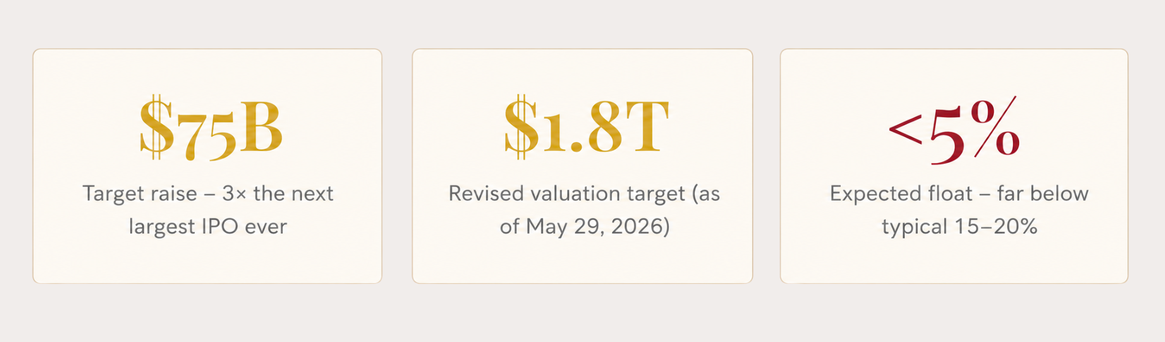
SpaceX is reportedly seeking to raise $75 billion in its initial public offering — approximately three times the size of the next largest IPO ever. The company is targeting a valuation of $1.75 to $1.8 trillion, which would instantly make SpaceX one of the most valuable publicly traded companies in the world. Shares are expected to begin trading as soon as June 12, 2026.
It is also worth noting that despite Starlink’s profitability, SpaceX reported a net loss of approximately $4.28 billion in just the first quarter of 2026 alone — nearly matching its loss for all of last year. The primary driver is its AI division, which is burning through roughly $1 billion per month. This is an important consideration for anyone evaluating the company’s fundamentals at a nearly $2 trillion valuation.
Nasdaq Is Both an Exchange and an Index — and That Distinction Matters
One important point for clients to understand is that Nasdaq is not only a place where stocks trade. It is also tied to major indexes, including the Nasdaq-100, which many ETFs and index funds are designed to track.
When a company enters that index, every fund tracking it is forced to buy shares so they can continue matching the benchmark.That forced buying is what makes index inclusion such a significant event.
SpaceX chose to list on Nasdaq rather than the NYSE — and the timing of that decision is no coincidence. Nasdaq recently changed its rules in a way that directly benefits SpaceX.
Historically, a company had to wait at least three months after going public before being considered for Nasdaq-100 inclusion.
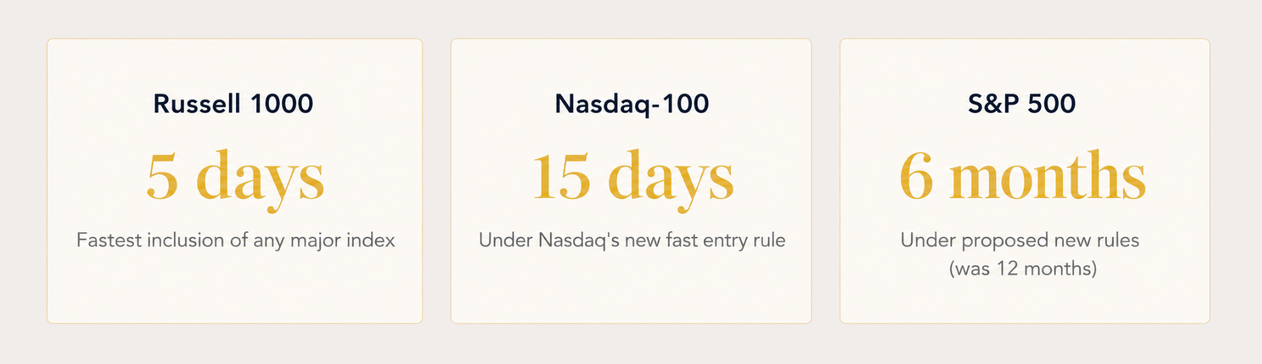
Nasdaq recently changed this to just 15 trading days for companies large enough to rank in the top 40 by market cap. What this means in plain terms: SpaceX could be in your index funds within weeks of going public — before it has gone through the kind of price discovery and volatility that typically seasons a new public company.
Here is a snapshot of how quickly SpaceX could work its way into various indexes once it goes public:
What History Says About Mega IPOs
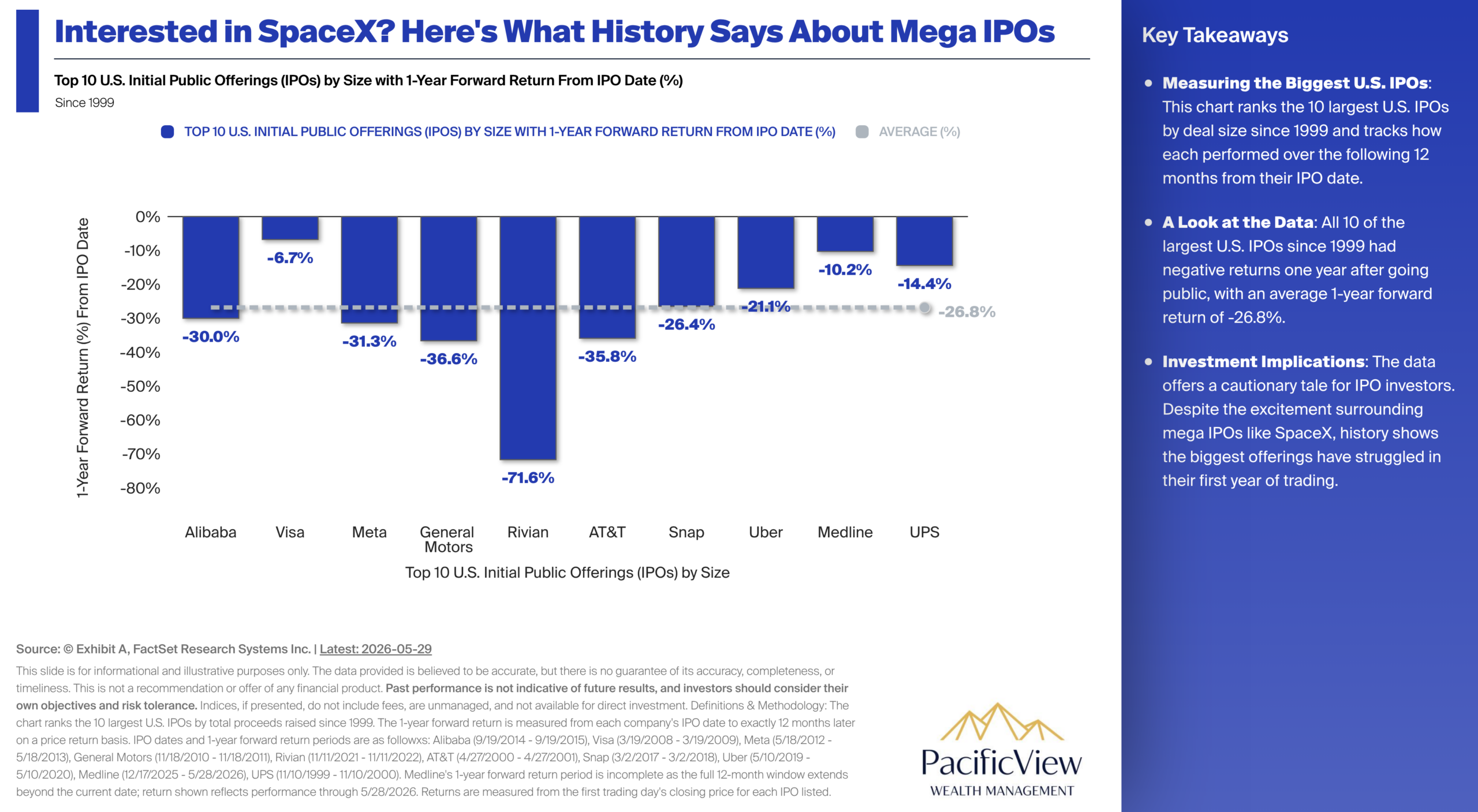
Despite all the excitement that typically surrounds large IPOs, the data tells a sobering story. Every single one of the 10 largest U.S. IPOs since 1999 produced negative returns in the first 12 months, with an average loss of -26.8%.
Even If You Don't Buy SpaceX, It May Already Be Headed Into Your Portfolio
This is the part that surprises most people. If you hold index funds — in your brokerage account, your IRA, or your 401(k) — SpaceX may find its way in automatically. Once it enters these indexes, every ETF tracking them is essentially required to buy shares at whatever price the market sets. That could happen within days of the IPO.
With a $1.8 trillion valuation, a $4.28 billion quarterly loss, and accelerated index inclusion all happening at once, there are a lot of moving parts — and a lot of questions worth asking.
OpenAI and Anthropic are also reportedly preparing to go public. How those companies structure their own IPOs will tell us a lot about whether these index rule changes become a lasting trend — and what it means for the long-term integrity of the benchmarks that many investors rely on through their retirement accounts and index funds.
We’re here to help you navigate what’s ahead.
Thank you for taking the time to read. As always, we’re here to help you make sense of the noise and focus on what matters most.
If anything in here sparked a question — about SpaceX, your portfolio, or anything else on your mind —we’d be happy to connect.
That’s what we’re here for.