

Markets have continued to show resilience in 2026, even amid volatility and global uncertainty.
Recently, we’ve seen stock prices pull back, yet many of the underlying fundamentals remain strong. So what’s really going on?
Let’s take a step back and walk through the bigger picture together.
In this month’s update, we’re highlighting a few of the key trends we’re watching, including earnings strength, economic resilience, labor market stability, and broader market leadership abroad.
Where To Begin
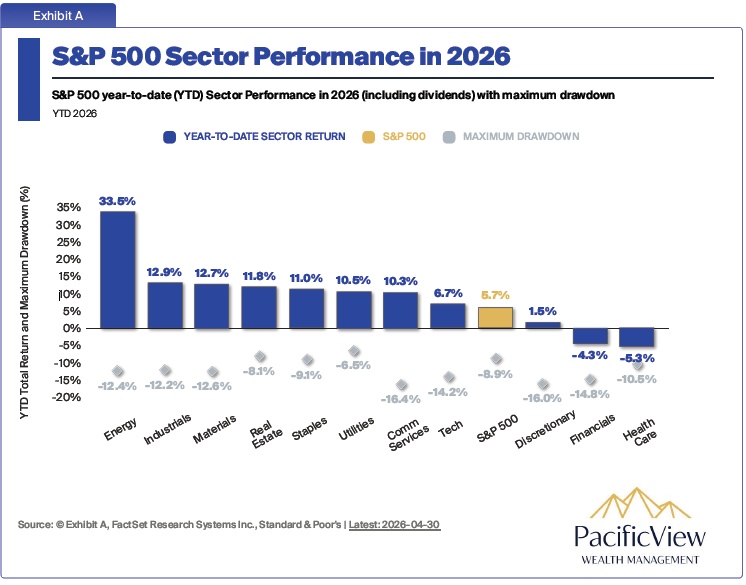
The S&P 500 has remained resilient in 2026 despite its 8.9% drawdown earlier this year. Through the end of April, the index is up 5.9% and 7 of 11 sectors are up double digit
Earnings Growth Has Accelerated
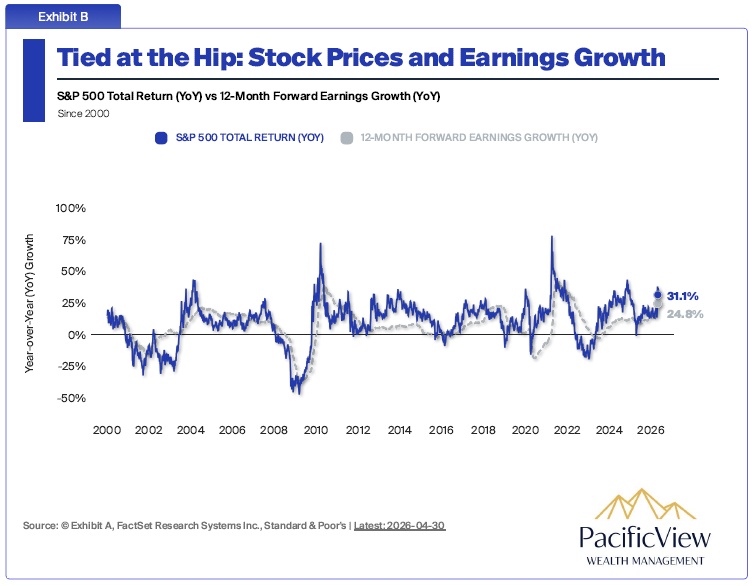
Many investors are scratching their heads right now trying to figure out why the stock market correction from the onset of the Iran War was so shallow and brief. Some people assume the market is detached from reality.
Fundamentals have historically been one of the main drivers of market performance over time. Stock price returns tend to have a strong relationship with earnings growth. It’s not a perfect relationship but expected earnings growth has accelerated, so it makes sense that the stock market is following fundamentals higher.
Economic Resilience
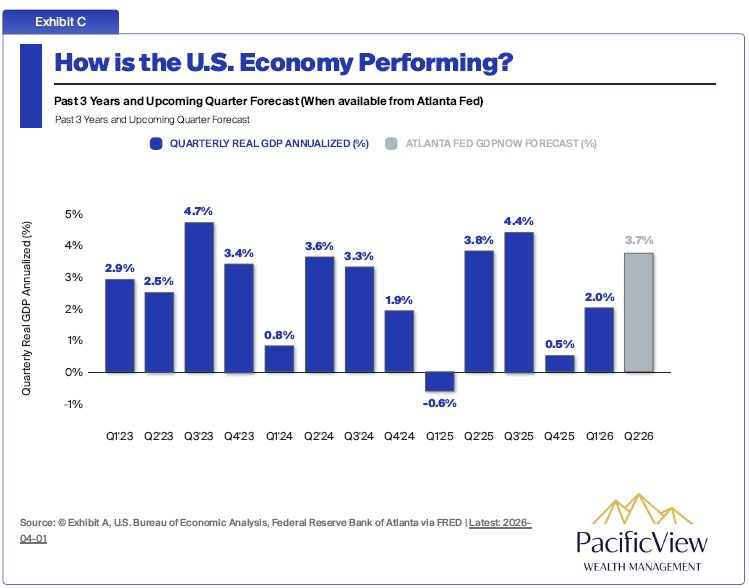
Much like the stock market, the U.S. economy doesn’t move in a straight line up and to the right.There are highs and lows, peaks and valleys. One constant of this cycle is the dynamism of the U.S. economy. There have been some quarters where growth lagged because certain parts of the economy (energy, housing, etc) slowed. But other parts of the economy have stepped up which has kept us out of a recession.
It’s important to remember that the consumer makes up roughly 70% of economic activity. As long as households continue spending, the economy is less likely to rollover. That resilience is reflected in current forecasts, with the Atlanta Fed expecting 3.7% annualized real GDP growth in Q2 2026.
The Labor Market Is Hanging in There
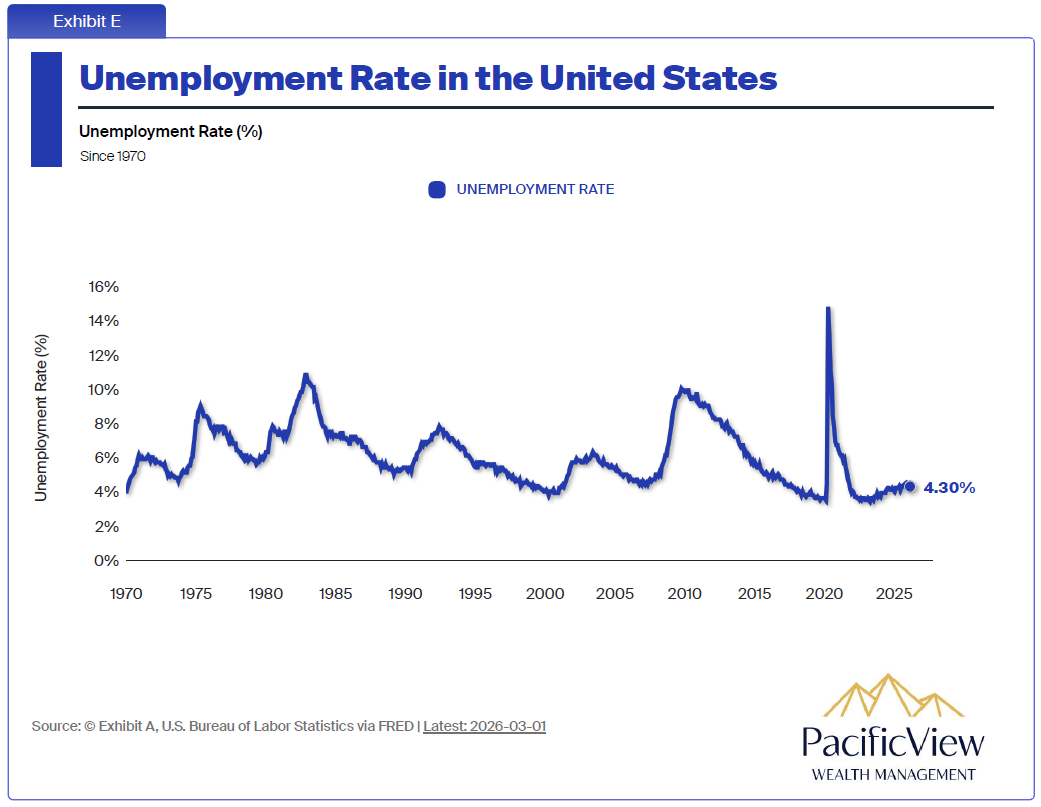
One of the main reasons the U.S. economy has been so resilient is the labor market. Following the surge in unemployment from the pandemic job loss, the unemployment rate has now been below 5% since the fall of 2021. And while hiring has slowed, it is not happening because of mass layoffs. Initial unemployment claims remain low by historical standards.
Households are still spending money because most people still have a job. If this situation were to deteriorate, it could present a meaningful risk to economic growth and consumer spending.
Emerging Markets Have Outperformed
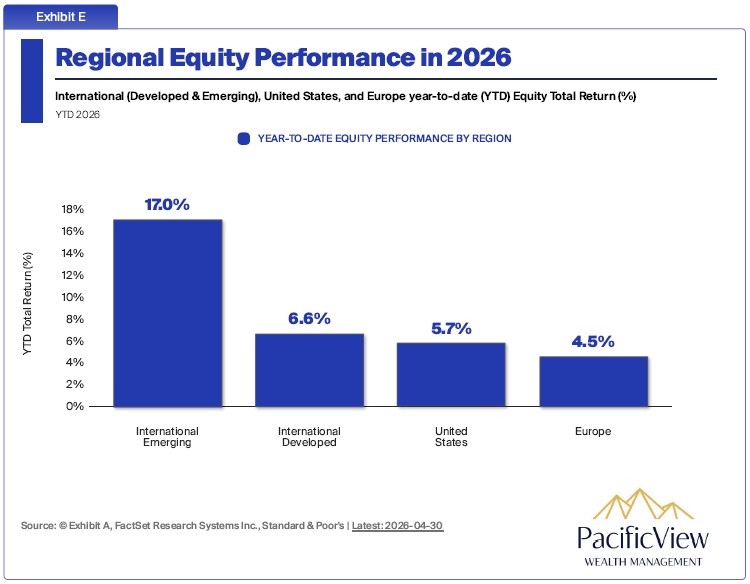
In the first decade of the 21st century, Emerging Markets outperformed the rest of the globe by a wide margin. Since the end of the Great Financial Crisis in 2009, EM has severely underperformed. Emerging Markets outperformed the rest of the world in 2025 and that outperformance has carried through into 2026 as well.
You can’t set your watch to these cycles, but it’s important to remember that markets are always and forever cyclical. No asset class outperforms or underperforms forever.
Don’t Be Fearful of All Time Highs
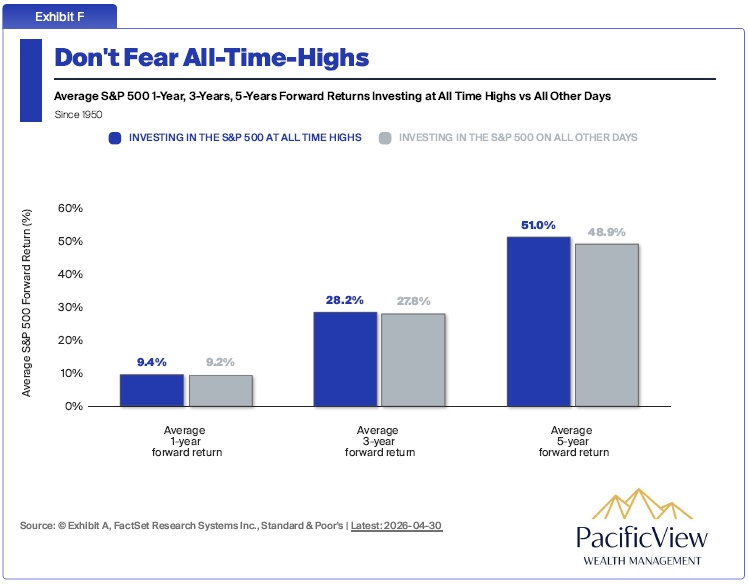
Following a brief 8.9% correction, the S&P 500 is back near all time highs. While any given high could ultimately precede a market downturn, history suggests that new highs are nothing to fear. The chart below, based on historical data since 1950, measures the average S&P 500 1-year, 3-year, and 5-year forward returns in two scenarios: after all time highs and after all other days (below highs).
The data suggests that the periods following all time highs have actually generated stronger forward returns versus other periods below highs. Counter intuitive, yes, but it’s the way markets have worked for over 75 years.
Difficult to argue with the data.
Volatility Clusters
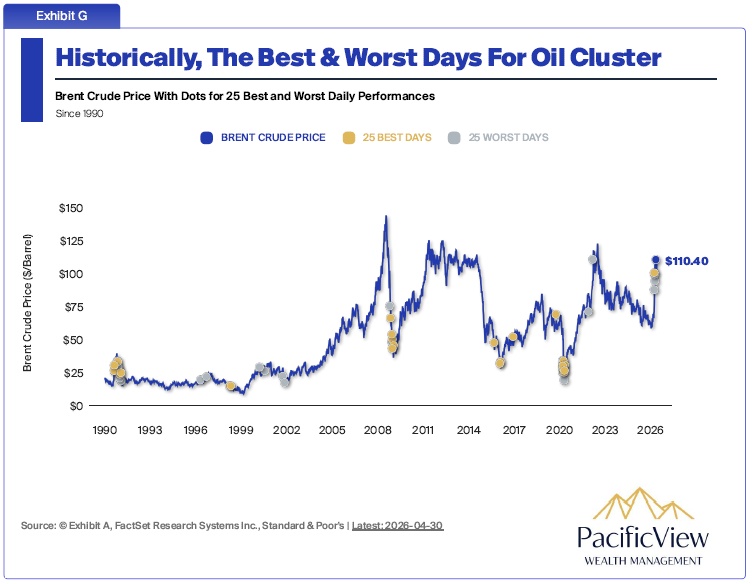
Volatility in the stock market has historically clustered around market downturns. This makes sense when you consider the fact that losses sting twice as bad as gains make you feel good.There are more panicked sellers and buyers when stock prices are going down.
Oil prices have a similar dynamic in that the best and worst days have historically clustered as well. This can happen during downturns and price spikes as the market searches for an equilibrium. When prices are moving fast in either direction, elevated volatility is not uncommon as investors try to find their footing. The chart below shows this.
Why Rising Energy Costs Haven’t Had a Big Impact
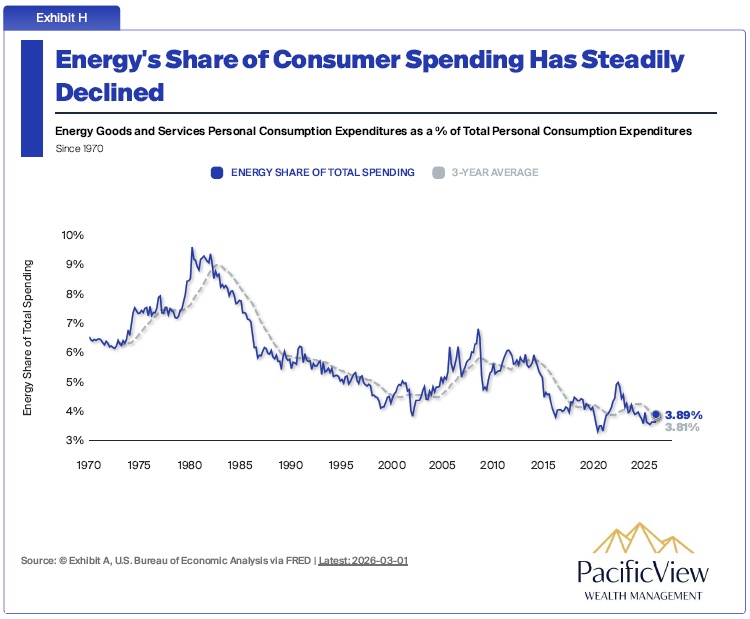
Many investors are confused about the current geopolitical situation. Oil prices have spiked which means gas prices are much higher than they were just a few short months ago.
Why hasn’t this had a bigger impact on the stock market? One of the reasons is that households don’t spend as much of their budget on energy costs as they did in the past.
Technology has made automobiles more fuel efficient. The global supply of energy has also expanded. Higher prices at the pump may be challenging for many households, though the data suggests consumers have more cushion than in prior cycles
We’re here to help you navigate what’s ahead.
Thank you for taking the time to read this month’s update.
If you have any questions about the markets, your portfolio, or anything covered here, please don’t hesitate to reach out.
We’re always happy to connect.